

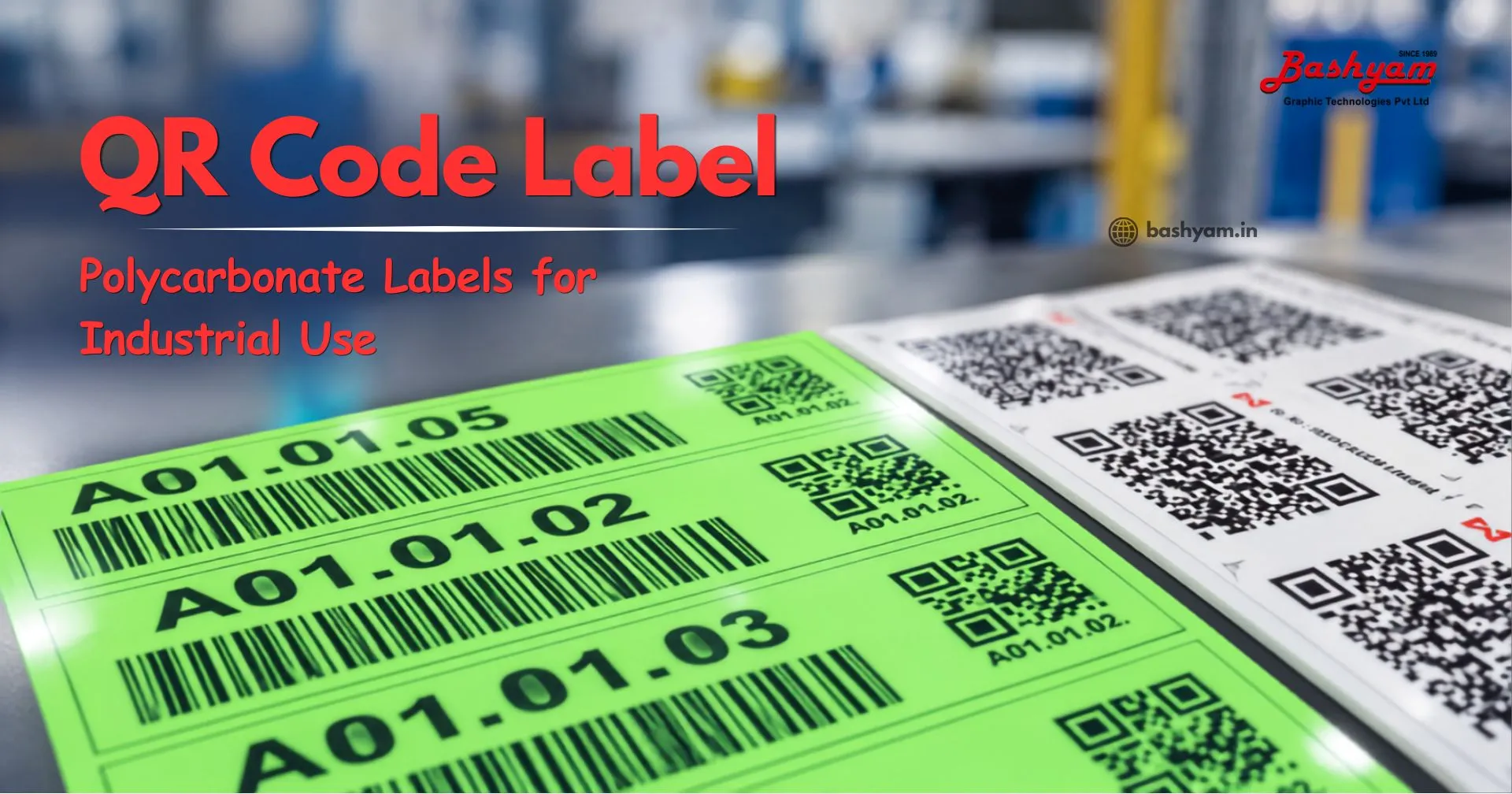
In industrial environments, labels need to do more than simply display information. They have to remain readable through handling, cleaning, heat, moisture and regular wear. A QR Code Label made from polycarbonate offers a practical way to combine product identification with reliable scannability.
Polycarbonate provides a more durable base for applications where ordinary paper or basic plastic labels may not provide enough durability. At Bashyam Graphics, labels can be produced to suit different equipment, products and identification requirements, with the printed information designed for clear and consistent scanning.
Industrial products are often exposed to conditions that can damage conventional labels. Dust, water, chemicals, abrasion and frequent handling can affect the printed surface and make important information difficult to read.
Polycarbonate provides a more durable base for applications where the label needs to stay in place and remain legible over time. A properly produced QR Code Label can carry a digital link, product information, identification number or tracking reference while maintaining a professional appearance.
The material is particularly useful for:
The quality of QR label printing has a direct effect on how easily a code can be scanned. A QR code may look simple, but the printed pattern needs sufficient contrast, definition and consistency for scanners and smartphones to read it accurately. For applications requiring additional durability, polyester sticker printing for durable industrial labels can also be considered based on the product surface and working environment.
Polycarbonate provides a stable surface for producing detailed codes and supporting information. When the artwork, size and printing process are properly selected, QR label printing can deliver labels suitable for demanding industrial applications.
The usefulness of a QR Code Label depends on what information needs to be connected to the physical product.
For example, a manufacturer may place a QR code on a machine so that technicians can quickly access its service documentation. A warehouse can use codes to identify individual assets, while a production facility may use them to associate components with specific records.
Not every application requires the same label construction. Before ordering, it is useful to consider where the label will be installed and what it will experience during its service life.
For an industrial QR Code Label, consider:
| Requirement | What to Consider |
|---|---|
| Surface | Flat, curved, textured or uneven |
| Environment | Indoor, outdoor, dusty or wet |
| Handling | Occasional or frequent contact |
| Information | QR code, text, serial number or logo |
| Size | Available space on the product |
| Readability | Required scanning distance |
| Adhesion | Type of surface and expected conditions |
| Finish | Matte, gloss or application-specific finish |
Discussing these details before production can help avoid problems such as poor adhesion, insufficient contrast or a code that is too small to scan comfortably.
One common mistake is reducing the QR code too much simply to fit more information onto a small label. A code needs adequate space and definition around its pattern so that scanners can identify it correctly. This is especially important when producing qr asset tags and custom qr code labels, where both the code and supporting information need to remain clear and easy to scan.
With QR label printing, the final size should be selected according to the intended scanning distance, printing method and available surface area. For asset identification applications, the label should provide enough room for the QR code, asset number and other essential details without compromising readability.
It is also important to test the finished sample rather than relying only on the digital artwork. A code that scans perfectly on a computer screen may behave differently after it has been printed, applied and exposed to the actual working environment.
Every application has different requirements. A small electronic component may need a compact code, while a large machine may have enough space for a larger label containing several identification details. Businesses working with sticker label manufacturers in chennai can also discuss the required label size, material and finish based on the intended application.
The right approach to QR label printing is therefore not simply choosing the smallest possible label. The design should balance available space, readability, durability and the amount of information required.
For businesses managing multiple products or equipment types, maintaining consistent label formats can also make identification easier for employees and support a more organised labelling system.
Looking for durable QR Code Labels for industrial equipment, products, or asset tracking? Bashyam Graphics can help you choose the right polycarbonate material, label size, finish, and printing format based on your application. Contact us today to discuss your requirements and get reliable QR labels designed for clear identification and long-term use.
1. What is a QR Code Label?
A QR Code Label is a printed label containing a scannable QR code that can connect physical products, equipment, or assets to digital information such as manuals, service records, product details, or tracking data.
2. Why is polycarbonate used for QR Code Labels?
Polycarbonate provides a durable labeling surface suitable for industrial applications where labels may experience moisture, dust, frequent handling, cleaning, and everyday wear.
3. Where can QR Code Labels be used?
QR Code Labels can be used on machinery, electrical panels, industrial equipment, tools, components, warehouse assets, products, and maintenance applications for identification and tracking.
4. What factors affect QR label printing quality?
QR label printing quality depends on factors such as label material, print clarity, contrast, code size, artwork, surface compatibility, and the printing process. Testing the finished label can help confirm reliable scanning.
5. How do I choose the right size for a QR Code Label?
The appropriate size depends on the available surface area, scanning distance, amount of additional information, and printing method. The QR code should remain clear enough for scanners and smartphones to read comfortably.
6. Can QR Code Labels be customized for industrial requirements?
Yes. QR Code Labels can be customized with details such as serial numbers, asset IDs, product names, logos, and other identification information. The material, size, finish, and layout can also be selected according to the application.